






Walk through a day-care infusion unit on a busy afternoon, and most patients will be sitting back in recliners, some of them for several hours. Nurses lean in now and then to check a line. A comfortable medical chair recliner sits at the centre of that routine, even if nobody mentions it much. Plenty of buyers look at the price tag first. That is fair, though the moving parts decide how the chair feels in its third year.
Here is why those parts deserve a closer look. A nurse might have to adjust the same chair several times in one session. The electrically operated, comfortable medical chair recliner that Esthetica Medical Furniture makes works as a handy reference here. Its feature list also doubles as a solid buying checklist, no matter which brand ends up on your purchase order.
Seating Patients with Swing-Away Arms on a Medical Recliner Chair
Getting Seated Without a Squeeze: With fixed armrests in the way, a patient has to shuffle in from the front of the seat. Swing-away side arms open outward, and someone with a walking stick can sit down from the side. Ask a charge nurse about chair features, and the arms will probably come up first. Perhaps that sounds minor.
Giving Staff Room Beside the Chair: With the arm swung back, a phlebotomist gets a clear reach to the patient’s arm. A 2023 MLO piece by the Clinical and Laboratory Standards Institute covers chair placement too. It recommends at least 76 cm by 122 cm of clear floor on one side of a phlebotomy chair. Does your current room provide that much space?

Reclining a Medical Recliner Chair All the Way Flat
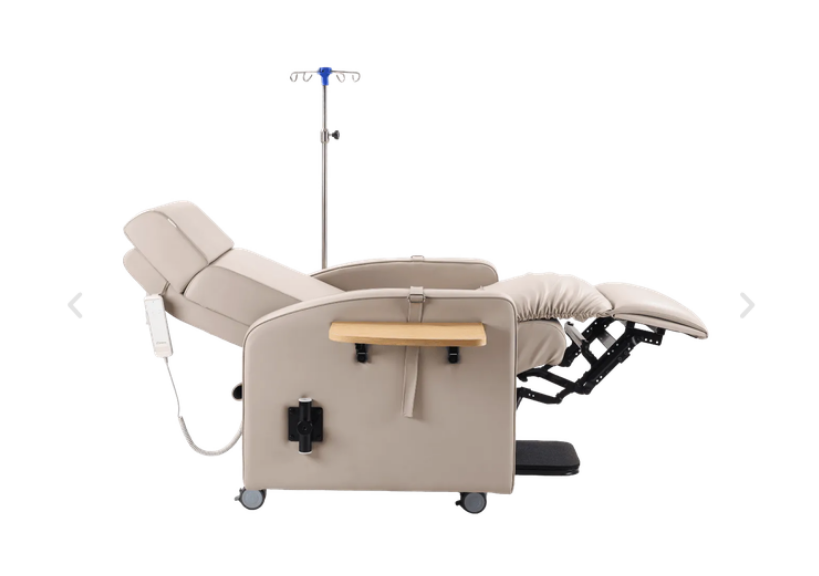
Switching Between Chair and Bed: A handheld remote moves the recliner from a seated posture to a flat bed. In chair mode, it measures 100 cm long and 121 cm tall. At full recline, the length grows to 177 cm, and the height drops to 87 cm. Staff will probably get the hang of the remote within a shift.
Using the Flat Position Less Than Expected: Honestly, plenty of sessions never touch the full recline. Then again, someone may want to lie back for a few minutes after giving blood. The same CLSI guidance suggests keeping reclining furniture near collection stations, with two recliners in larger centres. That situation comes up more than people expect.
Using the Retractable Footrest During Long Dialysis Sessions
Supporting Legs Through a Long Morning: A Hull University Teaching Hospitals NHS leaflet puts the standard haemodialysis prescription at four hours, three times a week. Altogether, that’s about 12 hours a week in one chair. A retractable footrest lets the legs rest at an easy angle, and staff can pull it back in before the patient stands up.
Keeping the Floor Clear Between Patients: A footrest left out can get in the way when someone steps off the chair. Once retracted, it frees up a little floor space for the cleaning trolley. It sounds like a small thing. Even so, housekeeping teams on a busy evening shift will probably be glad.
Looking at the Extras on a Comfortable Medical Chair Recliner
Checking the Trays and Side Tables: Patients on a four-hour session want somewhere within reach for a phone and a water bottle. Meanwhile, nurses want their own space for a chart or a dressing pack. The Esthetica recliner comes with these extras, according to its product page:
- Two fold-down side tables, one on each side.
- A built-in food tray, handy for patients who bring lunch from home.
- An IV pole stand.
- A handheld remote for the recline.
- Caster wheels, three inches across, for moving between bays.
Moving the Chair Between Bays: Units rearrange their treatment rooms more than anyone plans for. One person can probably wheel a chair on 3-inch casters to a new bay without much fuss. Of course, CLSI guidance says a chair on wheels must stay secured during a blood draw. Ask the supplier how the wheels hold still, and check it in person if you can.
Checking What Holds a Medical Recliner Chair Together
Starting with the Steel Frame: Esthetica builds the recliner at its own facility in IMT Manesar, Gurgaon, on a reinforced steel frame with a powder-coated finish. Besides, buying straight from a manufacturer can make spare parts a little easier to sort out years later. Ask about that anyway, before anyone signs the order.
Choosing Upholstery Staff Can Live With: Patients probably judge a comfortable medical chair recliner by its cushion and cover first. The upholstery here is phthalate-free and comes in four colours, including cream and mouse grey. Its technical sheet lists a Martindale abrasion figure of at least 200,000 cycles. Also, housekeeping should read the cleaning steps on that sheet before the first wipe-down.
Choosing a Comfortable Medical Chair Recliner for Your Facility
The next steps are fairly simple. Measure the bay first and note how many hours a day each chair stays occupied. Then compare those numbers with the dimensions on the product page. Esthetica Medical Furniture supplies clinics and hospitals across India and ships worldwide. Visit estheticamedicalfurniture.com to download the recliner brochure or send an enquiry.