






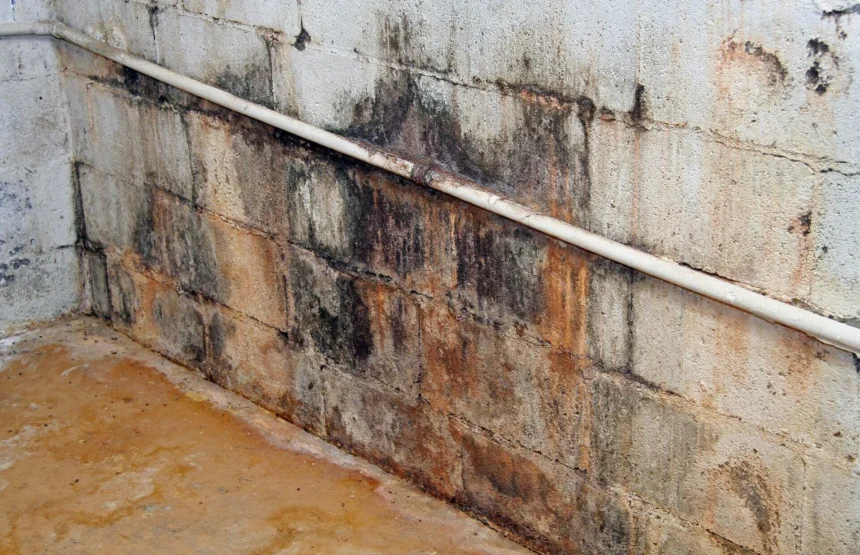
Basement water damage often starts when groundwater enters through foundation openings or drainage systems fail to remove excess water. Heavy groundwater pressure can force moisture through basement walls and floors; water entering these surfaces often leaves stains, damaged finishes, and raises indoor humidity. Repairs help fix leaking basement walls and address the source of intrusion. Here are a few signs you may have water damage in your basement:
1. Basement Wall Water Stains
Discoloration on basement walls often accompanies moisture intrusion, especially when stains spread, return, or appear alongside damp surfaces. Stain location helps guide the inspection but does not identify the source of moisture. Discoloration near the floor-wall junction warrants an assessment of groundwater conditions, while staining higher on the wall requires examination of the affected area. Changes after heavy rainfall or spring thaw also provide useful context when determining how to fix leaking basement walls.
Interior waterproofing manages groundwater beneath the basement floor through a perimeter drainage system. Installed near the foundation footing, the drain collects groundwater and channels it into a sump basin. A sump pump then discharges the water away from the foundation, limiting groundwater accumulation beneath the floor.
A wall vapor barrier directs moisture entering through basement walls toward the drainage system. It complements perimeter drainage but does not replace foundation crack repair. The repair approach depends on the source of moisture, whether wall seepage, groundwater pressure, or an opening in the foundation. Interior waterproofing systems are used with several foundation types, including:

- Pouredconcrete
- Cinderblock
- Brick
- Stone
2. Persistent Musty Basement Odors
A persistent musty odor in a basement often accompanies excess moisture, even without standing water or visible dampness. Poor ventilation allows damp air and odors to affect adjoining living spaces. Although the smell does not confirm mold growth, it warrants an assessment of indoor humidity and potential moisture sources. Dehumidifiers remove excess moisture from the air, while drainage systems collect groundwater and direct it to a sump pump. High-capacity, energy-efficient dehumidifiers provide humidity control in basements and crawl spaces.
3. Cracks in Foundation Walls
Cracks in basement foundation walls often result from settlement, hydrostatic pressure, or structural movement. Their direction and progression help guide the assessment, but the underlying cause requires further evaluation. Some cracks allow groundwater to enter; others indicate structural movement. The appropriate repair depends on the wall material, crack condition, and source of damage.
Crack injection seals suitable openings in poured concrete to prevent water intrusion. When cracks are the source of leakage, this method helps fix leaking basement walls. Sealing cracks does not correct underlying structural movement. Inward-bowing walls require stabilization when movement affects wall integrity. Steel I-beams brace the wall, while wall anchors connect it to more stable soil outside the foundation. Helical piers provide additional foundation support in certain settlement conditions.
4. Pooling Water on Basement Floors
Water pooling on a basement floor indicates moisture intrusion or inadequate drainage. The location and pattern of standing water help identify potential entry points, including floor cracks, foundation edges, and low areas. Groundwater pressure often forces water through floor cracks during heavy rainfall and spring thaw. Recurring pooling indicates that groundwater is entering faster than the existing drainage system removes it. Interior drainage systems collect groundwater beneath the basement floor and channel it to a sump basin. The drainage channel runs beneath the concrete slab, along the inside perimeter of the foundation footing, where it collects water from below the floor.
Fix Leaking Basement Walls Today
Professional waterproofing services address the underlying causes of basement leaks and provide solutions for leaking basement walls caused by foundation cracks and inadequate drainage. These services include foundation repair, interior drainage installation, sump pump systems, and moisture control. An inspection shows where water enters and which repairs may address the problem. Contact a basement waterproofing specialist for a foundation assessment today.